
The Book of Ruth is only four chapters long. It contains no miracles, no parted seas, no dramatic supernatural interventions. It is a quiet story about ordinary people navigating extraordinary loss — and about a God who works not through spectacle but through faithfulness, provision, and the unexpected kindness of human beings who choose to act like Him.
It is one of the most beautiful stories in all of Scripture.
The Setup: Everything Lost
The story begins with Naomi, an Israelite woman who had moved with her husband and two sons to the foreign country of Moab to escape a famine. In Moab, her sons married two Moabite women — Orpah and Ruth. Then, in rapid succession, Naomi’s husband died. Both of her sons died. She was left in a foreign country, widowed, childless, and utterly without provision.
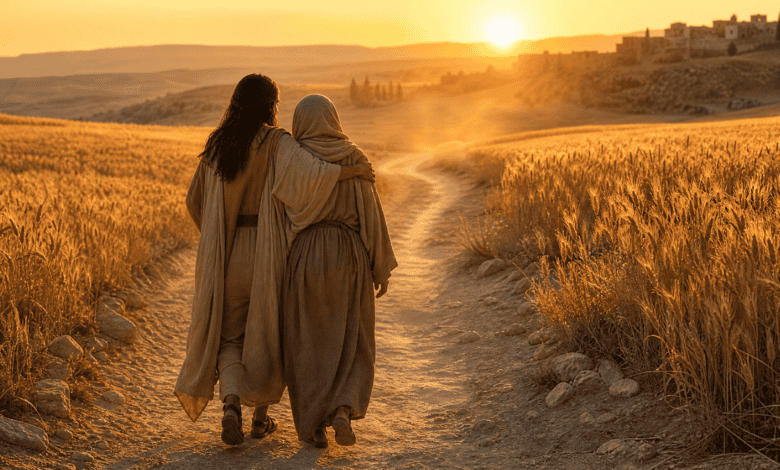
When she heard that the famine in Israel had ended, she decided to return home. She urged her daughters-in-law to return to their own families, where they would have the best chance of finding new husbands and rebuilding their lives. Orpah, with tears and genuine love, agreed to go. Ruth refused.
What Ruth said to Naomi in that moment is one of the most quoted declarations of loyalty in all of literature: where you go I will go, and where you stay I will stay. Your people will be my people and your God my God.
Ruth chose Naomi. She chose an uncertain future in a foreign land over the security of returning home. She chose love over logic. And in doing so, she stepped into one of the most beautiful redemption stories the Bible contains.
The Faithfulness in the Small
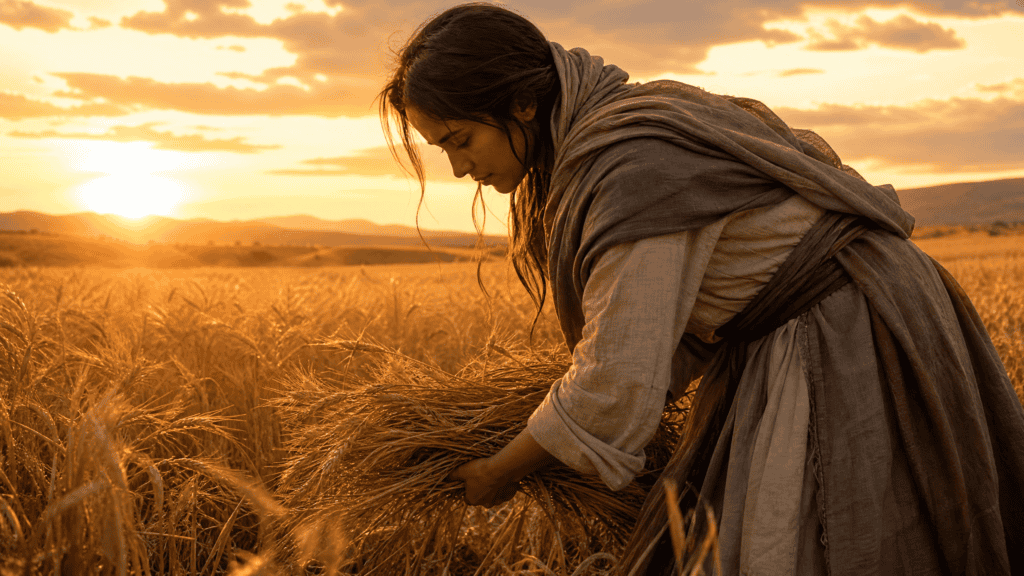
When Ruth and Naomi arrived in Bethlehem, they had nothing. Ruth went out to glean in the fields — a practice that allowed the poor to follow behind the harvesters and collect the grain they left behind. It was humble, exhausting work. But Ruth did it faithfully, without complaint, to provide for herself and her mother-in-law.
The field she chose — seemingly by chance — belonged to a man named Boaz, a wealthy and honorable relative of Naomi’s late husband. When Boaz noticed Ruth working in his field, he asked about her. When he heard her story — that she had left everything to care for her mother-in-law — he was moved. He instructed his workers to deliberately leave extra grain for her. He offered her water, food, and protection.
Grace found Ruth in a grain field. Not in a palace, not in a prayer meeting, not in a moment of supernatural encounter — in the ordinary, faithful, daily act of showing up and doing the humble work in front of her.
The Redemption
Under the ancient law of Israel, there was a provision called kinsman-redeemer — a relative who could purchase back land that had been lost and, in doing so, restore the family name and provide for the widow. Boaz was that relative for Naomi and Ruth.
When Ruth, guided by Naomi’s wisdom, made herself known to Boaz and asked for his protection, he did not hesitate. He honored the law, redeemed the land, and took Ruth as his wife. In one act of faithfulness and generosity, everything that loss had stripped away was restored — and more.
Ruth and Boaz had a son named Obed. Obed was the father of Jesse. Jesse was the father of David. And from the line of David came Jesus.
The Moabite widow who chose love over security, who gleaned in fields to survive, who refused to abandon the woman who had nothing left to offer her — she became part of the lineage of the Savior of the world. God wasted nothing. Not one tear, not one act of faithfulness, not one day of humble, unglamorous labor.
What Ruth’s Story Means for You
You may be in a season of loss right now. The thing you built may have fallen. The person you loved may be gone. The future you planned may have collapsed in ways you never anticipated. Ruth’s story does not minimize that grief. It honors it — and then it says: this is not the end.
God is a redeemer. He specializes in taking what loss tried to make permanent and restoring it into something more beautiful than what existed before. He does it through faithfulness — yours and His. He does it through the ordinary decisions to keep showing up, keep gleaning, keep choosing love when fear would be easier.
Your Boaz is in the field. Your redemption is closer than it looks.
“Where you go I will go, and where you stay I will stay. Your people will be my people and your God my God.” — Ruth 1:16